


Published: 24 July 2026 | UnionSPACE Thailand
At 12:01am Washington time this morning, the temporary 10% blanket tariff that had covered almost every US trading partner since February expired. It was replaced within the same minute.
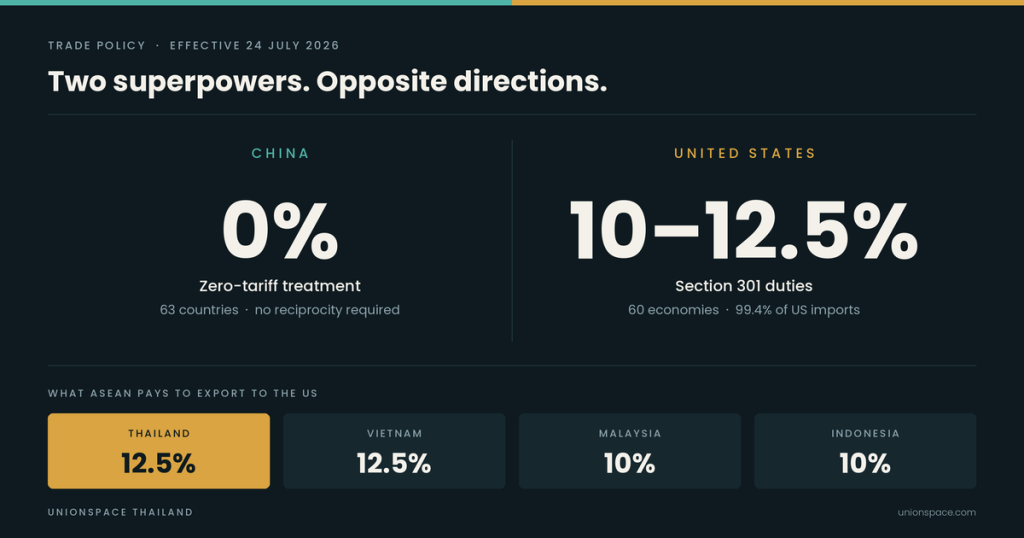
The United States now applies new duties of 10% to 12.5% on 60 economies — a group that covers 99.4% of everything America imports. Thailand is in the 12.5% band. Malaysia, Indonesia and Cambodia are in the 10% band.
That 2.5-point gap is small on paper and significant in practice. For a Thai exporter shipping USD 2 million a year to American buyers, it is roughly USD 50,000 in additional annual duty that a Malaysian competitor does not pay.
Here is what changed, why Thailand landed where it did, and what businesses operating here should be doing about it.
What Actually Happened This Morning
The sequence matters, because it explains why this feels sudden.
In February, the US Supreme Court ruled in Learning Resources Inc. v. Trump that the International Emergency Economic Powers Act does not give the President authority to impose sweeping tariffs. That struck down the legal basis for the “reciprocal” duties introduced in 2025 and forced refunds to importers who had already paid.
The administration responded with a 10% global tariff under Section 122 of the Trade Act of 1974 — a provision designed for balance-of-payments emergencies, and capped at 150 days. Those 150 days ran out today.
The replacement arrived through a different door. In March, the US Trade Representative opened Section 301 investigations into 60 economies, examining whether each had banned and effectively enforced a prohibition on imports made with forced labour. In June, the USTR found against all 60. The resulting duties took effect this morning.
Two rate tiers apply:
- 10% for economies that have a forced-labour import ban but enforce it imperfectly, or that made binding commitments under a reciprocal trade agreement — including Canada, the EU, Mexico, Indonesia, Malaysia, Cambodia, Taiwan and the UK.
- 12.5% for everyone else — including China, India, Vietnam, the Philippines, Singapore and Thailand.
Certain categories are exempt: energy, rare earths and some metals, beef, coffee, selected fruit and vegetables, pharmaceuticals, organic chemicals and aircraft parts. A separate mechanism for textiles and apparel is still being worked out, which matters for Thai manufacturers in that sector.
Why Thailand Is in the Higher Tier
This is the part worth understanding properly, because it is not really about labour standards.
The investigation did not assess whether forced labour occurs in any given country. It assessed whether a country has built an import-prohibition system meeting US specifications, and whether it enforces one.
Look at how the tiers were assigned and a clearer pattern emerges. Malaysia and Cambodia do not have compliant systems either — but both committed to building them under reciprocal trade agreements signed with Washington, and both received the 10% rate. Thailand and Vietnam remain at framework-agreement stage, and both received 12.5%.
In other words, the tier reflects how far a country has moved toward accepting US trade conditions.
Thailand’s position has been deliberate. The Ministry of Commerce sent a team to brief the USTR in May, presenting capacity-utilisation data to rebut a separate allegation, and worked with the Board of Investment to demonstrate that Thai industry is not heavily subsidised. The US came back with 17 questions, all answered within two hours — fewer than the 29 put to Malaysia, 32 to Vietnam, or 36 to Indonesia.
The government has chosen to protect certain domestic interests rather than sign everything on the table. The 2.5-point differential is the price of that choice. Whether it proves correct depends on how the next round of negotiations goes — and Thailand is still at the table.
The Other Half of the Map
While Washington was rebuilding tariff walls, Beijing spent the same period taking them down.
China’s customs authority confirmed on 22 July that its zero-tariff policy now covers 63 countries. The largest single expansion came on 1 May, when duty-free treatment was extended to all 53 African nations holding diplomatic relations with China — adding 20 middle-income economies to the 33 least-developed African countries already covered since December 2024.
The access is unilateral. No reciprocal concessions are required, and unlike Western preference schemes, it carries no governance or human-rights conditionality. The one condition is diplomatic: Eswatini, which recognises Taiwan, is excluded.
Beijing has paired the tariff cuts with operational measures — risk-based customs management, integrated market-access procedures, and expanded “green channels” for agricultural and food products. China-Africa trade rose 19.6% year-on-year in the first half of 2026.
Two Playbooks, Side by Side
| Dimension | China | United States |
|---|---|---|
| Primary tool | Unilateral zero-tariff lines, green channels | Section 301 duties of 10%–12.5% |
| Coverage | 63 countries, no reciprocity required | 60 economies, 99.4% of US imports |
| Legal basis | Domestic tariff policy, WTO Enabling Clause | Section 301, Trade Act of 1974 |
| Stated goal | Expanded opening-up, market diversification | Forced-labour enforcement, reciprocity |
| Practical effect | Resource security, supply-chain depth, RMB settlement | Domestic manufacturing protection, negotiating leverage |
| Approach | Non-reciprocal, condition-light | Transactional, enforcement-driven |
What This Means If You Do Business in Thailand
Policy analysis is only useful if it changes what you do on Monday. Four groups should be paying attention.
If you export to the United States
Model the 12.5% now, not after your next shipment clears. Check first whether your HS codes fall under an exemption — the carve-out list is broader than most coverage suggests, and energy, pharmaceuticals, organic chemicals and several agricultural categories are outside the scope.
If you are in textiles or apparel, watch the separate mechanism closely. The USTR has signalled it may allow certain volumes in at a reduced rate, linked partly to how much US cotton or textile input a partner buys. That could materially change the calculation.
If you are choosing a regional base
The honest read: the 2.5-point differential is real but it is one variable among many, and it is not permanent. Thailand remains at framework-agreement stage, which means the rate is a negotiating position rather than a settled outcome.
Weigh it against what does not change quickly — BOI incentives, engineering and manufacturing depth, logistics infrastructure, cost of living, and the quality of the talent pool. Companies that relocated purely on tariff arbitrage in 2019 spent the following five years relocating again.
A more defensible structure for many firms is dual-presence: a Thai operating entity supported by a second regional office, giving flexibility as rates move. That is a strategy that only works if setting up a second location is cheap and fast — which is precisely the case in a serviced environment.
If you are a foreign founder or SME here
The direct impact is limited unless you are shipping physical goods to America. The indirect impact is not.
Expect slower decision cycles from US-facing clients, more scrutiny on landed costs, and more interest from firms diversifying away from single-market exposure. Service businesses, software companies and consultancies are largely insulated on the tariff line itself, but not from the caution their clients are feeling.
If you are watching where the growth is
Look at where trade is being actively liberalised rather than restricted. China-Africa trade grew 19.6% in six months. Intra-ASEAN integration is being pushed harder as a direct response to US pressure — harmonised customs procedures, unified rules of origin, dismantled non-tariff barriers. RCEP remains underused by Thai SMEs.
Concentration risk is the lesson of the past eighteen months. Businesses with a single dominant export market have had a difficult year regardless of which market it was.

What to Watch Next
Three things are still unresolved:
- The excess-capacity investigation. A separate Section 301 case covering 16 economies — including Thailand, Vietnam, Malaysia, Cambodia, Indonesia and Singapore — has not yet produced proposed tariffs. It targets automotive, rubber and machinery. Thailand has exposure in all three.
- The textile mechanism. Still being defined, and significant for Thai apparel exporters.
- Negotiations. Thailand and Vietnam remain at framework stage. Malaysia and Cambodia moved to the lower tier by making commitments. The 12.5% rate is not necessarily where this ends.
The Bottom Line
Two of the world’s largest economies are running opposite experiments at the same time. The US is trading near-term consumer purchasing power for long-term industrial leverage. China is using immediate import openness to build a resource-secure economic bloc across the developing world.
Thailand sits between them, which is uncomfortable in the short term and potentially valuable in the long term. Neutrality has a cost — 2.5 percentage points, this quarter. It also has a value: businesses that need optionality across both blocs increasingly need a base that is not locked to either.
That is the case Thailand has to make over the next twelve months. For companies operating here, the practical response is the same one that has worked through every trade cycle: know your exposure, diversify your markets, and keep your structure flexible enough to move when the rules do.
Setting up or restructuring in Thailand?
UnionSPACE supports international businesses across Bangkok, Pattaya, Chiang Mai and Hat Yai with workspace, company registration, accounting and visa services — so you can establish or relocate an operating base without a twelve-month lease commitment.
[Talk to our team →] [Book a tour →]
Q: What is the US tariff rate on Thailand in 2026? A: Thailand faces a 12.5% Section 301 tariff on goods exported to the United States, effective 24 July 2026. The rate was set under a US Trade Representative investigation into forced-labour import enforcement. Certain categories, including energy, pharmaceuticals and some agricultural products, are exempt.
Q: Why is Thailand’s US tariff higher than Malaysia’s? A: Malaysia committed to introducing a forced-labour import prohibition system under a reciprocal trade agreement with the United States, placing it in the 10% tier. Thailand remains at framework-agreement stage and was placed in the 12.5% tier.
Q: Which ASEAN countries face the 12.5% US tariff? A: Thailand, Vietnam, the Philippines and Singapore are in the 12.5% tier. Malaysia, Indonesia and Cambodia are in the 10% tier.