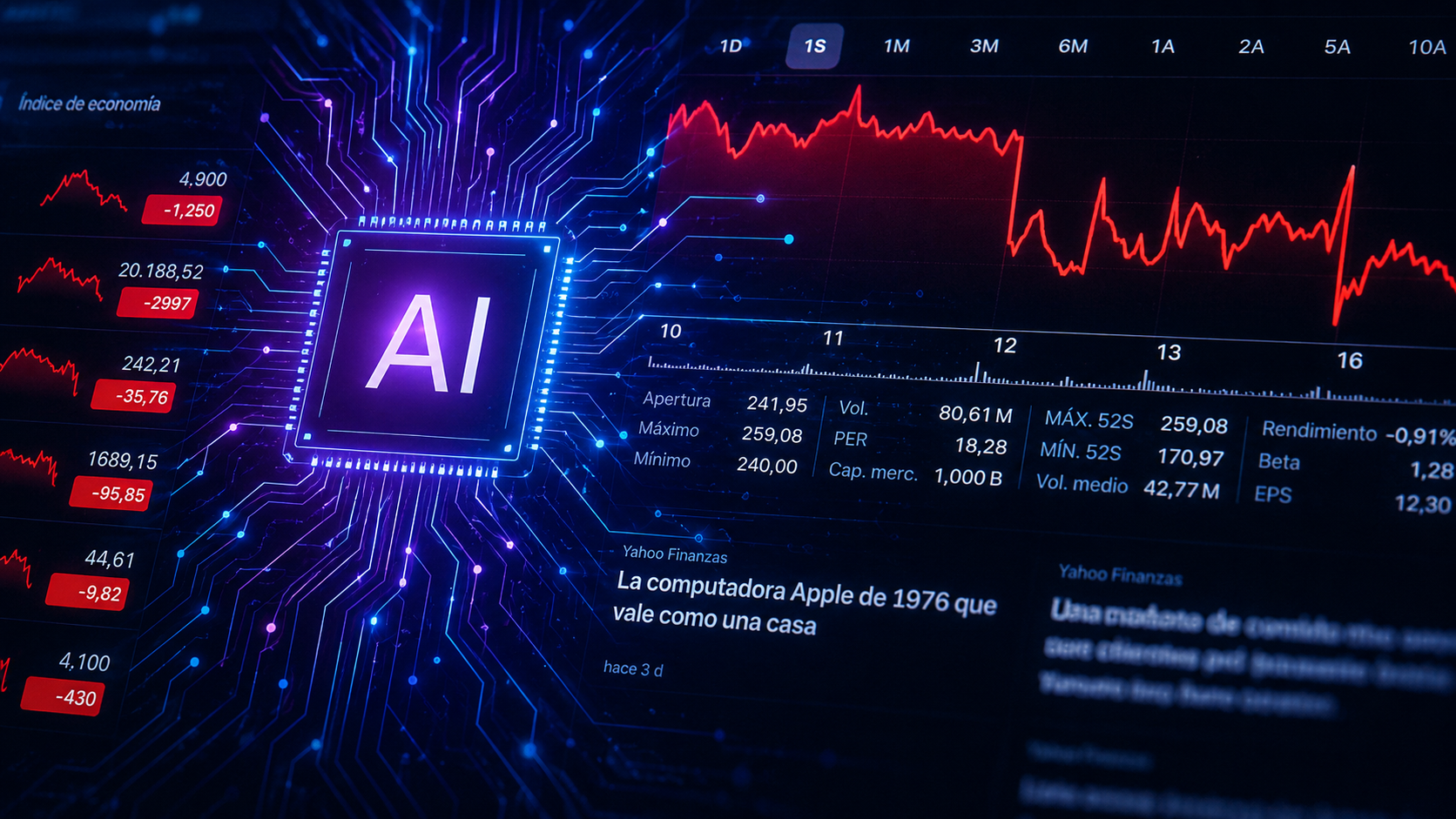











After two years of a historic rally, 2026 has become the year investors started asking the uncomfortable question out loud: is AI a bubble? A brutal June sell-off, warnings from Wall Street’s biggest names, and valuations not seen since the dot-com era have turned a background worry into a front-page debate. Here’s what’s actually going on — and both sides of the argument.
What Happened in June 2026
The nerves became a rout. In late June, a wave of selling hit technology stocks worldwide as doubts grew over whether the massive spending on AI is actually worth it. On June 23, the tech-heavy Nasdaq dropped 2.2% and the S&P 500 fell 1.4%, while South Korea’s KOSPI collapsed 10% and briefly halted trading to prevent a crash. Shares of memory-chip giants Samsung and SK Hynix lost 12% in a single morning.
The poster child for the anxiety was Micron Technology, whose stock had risen nearly 800% over the previous year on AI-memory demand — then plunged 13% amid the sell-off. By June 26, the Nasdaq had fallen roughly 5%, and Oracle, a heavy AI investor, closed its worst week since the dot-com bubble with a 19% drop.
Why People Are Worried (The Bear Case)
The case for a bubble rests on a few striking numbers. First, the spending is staggering: total AI investment is projected to exceed $2.5 trillion in 2026, with the big hyperscalers (Alphabet, Amazon, Meta, Microsoft, and Oracle) alone expected to spend around $755 billion this year.
Second, the returns haven’t shown up yet. The central tension is the disconnect between roughly $400 billion in AI infrastructure spending and only about $100 billion in enterprise AI revenue. An MIT study found that around 95% of businesses investing in AI have not yet made a profit from it.
Third, valuations are stretched to historic extremes. The Shiller cyclically-adjusted P/E ratio for the US market exceeded 40 for the first time since the dot-com crash. Market concentration is also unprecedented — the top ten stocks now make up around 35% of the S&P 500, versus 25% at the dot-com peak, and AI-linked companies accounted for roughly 80% of US stock market gains over the past year. If those few names fall, they drag everything with them.
Finally, prominent voices are sounding alarms. Bridgewater’s Ray Dalio said his “bubble indicators” show US equities close to their 2000 and 1929 levels, JPMorgan’s Jamie Dimon has voiced concern, and Chinese hedge funds have warned of an AI “super bubble.” One analyst went as far as calling the AI boom 17 times bigger than the dot-com bust.

Why It Might Not Be a Bubble (The Bull Case)
The other side argues this time is genuinely different — and the data backs much of it up. Unlike the dot-com era, when countless companies had no revenue and no path to profit, today’s AI leaders generate enormous real profits. The “Magnificent Seven” enjoy net margins above 25%, roughly double the S&P 500 average, and Nvidia alone posted around $99 billion in trailing profit at a 53% net margin.
Valuations, while high, aren’t dot-com crazy. Nvidia trades at roughly 24–26 times expected earnings — elevated, but a world away from Cisco’s 472 times earnings at the 2000 peak.
Crucially, the spending is being funded from strength, not debt. Companies have funded their AI capital expenditures almost entirely from earnings rather than borrowing — a sign the build-out isn’t creating the kind of systemic financial fragility that turns a correction into a crisis. Goldman Sachs and J.P. Morgan both argue the growth is fundamentally justified, with real demand for AI chips coming from paying enterprise customers, not speculative startups.
The Nuanced View: A Bubble in Parts, Not the Whole
The most balanced reading is that 2026 shows bubble-like conditions in specific segments rather than a market-wide speculative frenzy. Some pockets look frothy — SpaceX’s IPO valued it at over 100 times sales, and certain chip names trade at price-to-sales ratios above 30, levels that have historically preceded sharp corrections. But the profitable core of the AI economy rests on far firmer ground than the internet bubble did.
It’s also worth remembering Ray Dalio’s key distinction: a bubble forming and a bubble bursting are two different events. The “pricking” usually comes when investors are forced to sell assets to raise cash — and the most-watched trigger for that is rising US interest rates, which make future earnings less valuable and AI borrowing more expensive. Notably, June’s sell-off was set off partly by a strong jobs report that revived fears the Federal Reserve might hike rates rather than cut them.
The Bottom Line
The real question in 2026 is no longer whether AI is transformative — it’s whether today’s prices have already fully priced in that transformation. A bubble doesn’t form simply because prices rise; it forms when prices rise faster than the underlying fundamentals. AI’s fundamentals are real and profitable at the core, but the gap between trillions in spending and still-modest returns is the crack everyone is watching. Whether that gap closes with growth or with a correction may be the defining market story of the next few years.